
The Hour That Almost Didn’t Happen
Updated: Sep 1

Castries, St. Lucia,
December 2025
Yesterday was supposed to be a workday.
I was in my apartment outside Castries, spending the morning working with coaching clients by phone and catching up on the unglamorous but necessary details of running a private practice while traveling through the Caribbean. Emails, schedules, logistics. The scaffolding that quietly holds a life like mine upright.
And yet, underneath all that productivity, my body kept making the same request:
Go to the sea.
I've always been drawn to the ocean. I grew up in California, where the Pacific is never far away. But the ocean near me in San Francisco is too cold and dangerous to go in, for me. That's one of the reasons I wanted to come to the Caribbean after my knee surgeries. I wanted to be in the warm water.
I'm not a strong swimmer. When I was eight years old, I almost drowned. I never learned to swim because putting my head underwater brought back the trauma.
I love what the sea gives me. And because of what happened when I was a child, I never forget what it's capable of taking away.
And yet, I love being immersed in the sea when I feel safe.
In soft waves, it almost feels like partner dancing. When a swell comes toward me, I bend my knees and spring up a little, letting the water lift me before it gently sets me down again.
I wanted that today.
So, I asked for help.
Janell, the manager of the apartment complex, offered to find a taxi driver to take me to a nearby beach—one with calm water, gentle waves and people around. Somewhere I'd feel safe.
Originally, I'd hoped to go around 4 pm so that I could finish my work first. I still had admin to do, and I needed to pack for the ferry to Martinique the next day. I know myself well enough that once I've been in the sea, I'm off the clock.
By late afternoon, traffic around Castries slows to a crawl. Janell had to make a few phone calls before she finally found a taxi driver willing to pick me up — but only at 2:30 pm.
I really wanted to finish my work.
And I really wanted to go to the sea.
At the time, I felt conflicted.
Looking back, it was perfect.
It had been raining on and off most of the day. Janell even suggested, kindly but firmly, that maybe I shouldn't go in the sea today after all.
It was my last full day in Saint Lucia. I thought I should just finish my work, pack my suitcase, and make tomorrow a little easier.
But the sea kept calling me.
I checked the weather app.
It said the rain had finished for the day.
That settled it.
I was going to the sea.
The taxi driver said he'd be back in an hour.
We agreed I'd stay near where he dropped me off, and when he returned, he'd come find me.
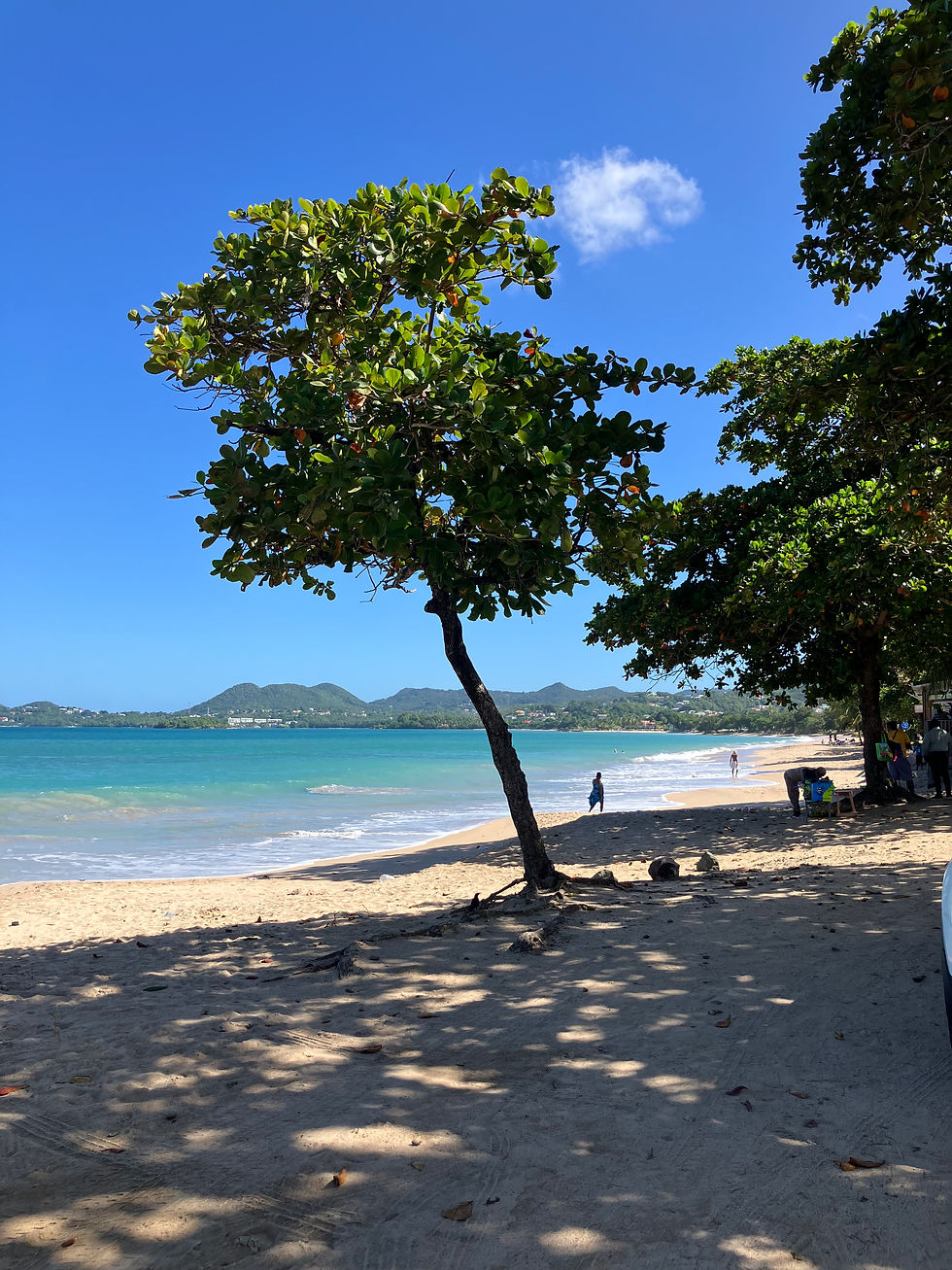
There were a few people in the water—an older couple from Sweden. We began chatting the way people do when the sea softens boundaries. We talked about San Francisco, my upcoming trip to Stockholm and the Åland Islands, and how travel can make the world feel both vast and surprisingly small.
They soon got out of the water, but their adult daughter, Sandra, came in just as they were leaving.
As Sandra and I continued the conversation, it turned to what we both did. I told her I was a coach and therapist, and that I was writing a book about two traits that I have myself — High Sensitivity and High Sensation Seeking. In my own work, I call those Depth and Reach.
I asked if she'd ever heard of The Highly Sensitive Person by Elaine Aron.
"Oh yes," she said. "I've read that book. I'm one of them."
Within moments, we were talking about what it was like to move through the world as highly sensitive people—how the trait showed up in our lives, the challenges it brought, and the gifts.
A little later, I mentioned that I wasn't a strong swimmer.
She smiled.
"Don't worry," she said. “I am. I've got you."
I trusted her.
I relaxed a little more.
I let the sea hold me as I enjoyed dancing with the swells and talking with Sandra.
Eventually, without knowing the time, I began to feel ready to get out.
Just then, Sandra said she was getting cold. It was a rare cool day—the rain had shifted the air, and the water carried that change.
We headed toward shore.
My new knees were still not quite strong enough to pull me through the surf, so getting out of the water wasn't easy. Thank goodness her parents were there. It took all three of them—steady and patient—to help me make my way back onto the sand.
We all stood there together, laughing a little, catching our breath.
It was exactly 3:30 pm.
And right on cue, my driver came walking up the beach calling my name.
Everything had fallen into place.
Perfectly.
Without effort.
Back in my apartment, the meaning began to sink in.
If Janell hadn't kept calling taxi drivers...
If I'd decided to work instead...
If I'd stayed inside because it might rain...
I never would have met Sandra.
I never would have had that hour, when the same experience fed both Depth and Reach in different ways.
Depth felt safe in the sea and felt seen without having to explain. Reach delighted in dancing with the swells and an unexpected conversation.
And then, as if to underline the point, the sky opened.
A tropical downpour arrived moments after I got home. Rain poured down hard enough to make it unmistakable. That window had closed.
The timing hadn't just worked out.
It had been exact.
Most of the time, I'm learning the rhythm of letting Depth and Reach take turns.
But every once in a while, life offers an experience generous enough to nourish them both at the same time.
Yesterday, that happened in the sea.
A Note Before You Go
If you recognized yourself in this story, you’re not alone.
I’ve created a free 30-second quiz and a free short booklet, An Introduction to Depth and Reach, to help you learn a little more about these two traits.
I hope they help you understand yourself a little better.
I’d love to share them with you.

Comments